Powertrain Architecture

Ram RHO 3.0L Hurricane: Twin-Turbo Engine Specs

The 2025 Ram 1500 RHO is powered by Stellantis's 3.0-liter Hurricane High-Output twin-turbo inline-six engine, delivering 540 horsepower at 5,200 RPM and 521 lb-ft of torque at 3,500 RPM under 26.0 PSI of boost on 93 AKI premium fuel while weighing 150 pounds less than the outgoing 6.2L HEMI V8.

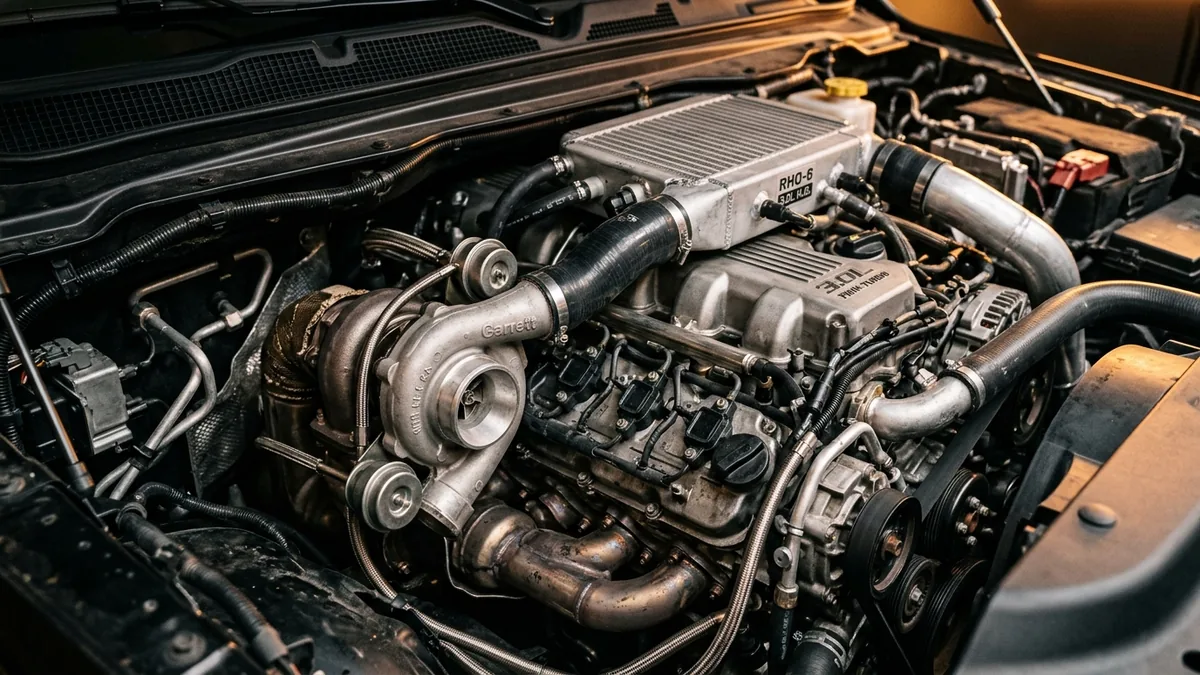
2025 Ram 1500 RHO 3.0L Hurricane High-Output twin-turbo inline-six engine bay and Garrett turbochargers
3.0L Hurricane High-Output Twin-Turbo I6 Architecture · Conceptual visualization developed under human technical direction · Verified against Stellantis Hurricane H.O. technical specifications.

3.0L Hurricane H.O. Octane Derating, Wastegate Boost & Fuel Cost Calculator

Simulate ECU knock-sensor ignition timing retard, twin Garrett turbocharger boost ceilings, density-altitude compensation, and annual fuel expenditure across 93, 91, and 87 AKI octane grades.

Select Fuel Octane Rating (AKI R+M/2)
1,000 ft
0 ft Sea Level 4,000 ft High Desert 8,000 ft Mountain Pass
15,000 mi/yr
5,000 mi 15,000 mi Avg 25,000 mi Fleet
$0.80/gal
$0.60/gal $0.85/gal $1.10/gal
Net Crank Output 540 hp / 521 lb-ft ~468 whp @ 13.3% AWD loss
Peak Boost & Timing 26.0 PSI / +0.0° Wastegate Duty: 76%
Estimated 0-60 Impact 3.50s (Optimal) 1/4 Mile: 12.80s @ 107.4 mph
Annual Fuel Cost Delta +$706/yr 17.0 MPG Combined (882 gal/yr)

Notice: This calculation engine models published statutory formulas and regulatory codes for informational and planning purposes only. It does not provide certified legal, medical, veterinary, tax, or engineering advice. For definitive rulings, consult an actively licensed professional in your jurisdiction.

Garrett Twin-Turbo Telemetry Overlay

1,500–6,000 RPM Horsepower, Torque & Knock-Retard Curves

93 AKI Reference (540 hp / 26.0 PSI) Selected Calibration (93 AKI @ 1,000 ft)
600 hp 500 hp 400 hp 300 hp 200 hp 100 hp 1500 RPM 2400 RPM 3500 RPM 4500 RPM 5200 RPM 6000 RPM 540 HP @ 5,200 RPM (26.0 PSI)
SAE J1349 Certified Blueprint

Ram RHO Engine Specs: 3.0L Hurricane High-Output vs Standard-Output Matrix

Analyzing official Ram RHO engine specs confirms that the High-Output 3.0L Hurricane inline-six (code EFC) shares its 2,993 cc displacement and Plasma Transfer Wire Arc bore coating with the Standard-Output model, but substitutes forged pistons, a 9.5:1 compression ratio, dual 350-bar fuel pumps, and 26.0 PSI Garrett turbochargers.

Engine Blueprint Parameter Ram 1500 RHO 3.0L Hurricane H.O. Ram 1500 3.0L Hurricane S.O. 2024 Ram TRX 6.2L HEMI V8
Engine Code & Family Stellantis GME-T6 High-Output (EFC) Stellantis GME-T6 Standard-Output (EFB) Chrysler Hellcat HEMI V8 (ESD)
Displacement & Layout 2,993 cc (3.0L / 182.6 cu in) DOHC I6 2,993 cc (3.0L / 182.6 cu in) DOHC I6 6,166 cc (6.2L / 376.0 cu in) OHV V8
Bore × Stroke Geometry 84.0 mm × 90.0 mm (Undersquare 1.07:1) 84.0 mm × 90.0 mm (Undersquare 1.07:1) 103.9 mm × 90.9 mm (Oversquare 0.87:1)
SAE Certified Horsepower 540 hp @ 5,200 RPM (180.4 hp/L) 420 hp @ 5,200 RPM (140.3 hp/L) 702 hp @ 6,100 RPM (113.8 hp/L)
SAE Certified Peak Torque 521 lb-ft @ 3,500 RPM 469 lb-ft @ 3,500 RPM 650 lb-ft @ 4,800 RPM
Forced Induction System Twin Low-Inertia Garrett Mono-Scroll Turbos Twin Smaller-Trim Mono-Scroll Turbos 2.38L IHI Twin-Screw Supercharger
Maximum Boost Pressure 26.0 PSI (1.79 Bar Gauge) 22.0 PSI (1.52 Bar Gauge) 11.0 PSI (0.76 Bar Gauge)
Static Compression Ratio 9.5:1 (Forged Aluminum Pistons + DLC Pins) 10.4:1 (Cast Aluminum Pistons) 9.5:1 (Forged Alloy Pistons)
Fuel Injection Architecture Dual High-Pressure 350-Bar (5,075 PSI) GDI Single High-Pressure 350-Bar (5,075 PSI) GDI Sequential Multi-Port Fuel Injection
Block & Cylinder Bore Metallurgy Deep-Skirt Cast Aluminum + PTWA Spray Bore Deep-Skirt Cast Aluminum + PTWA Spray Bore Deep-Skirt Cast Iron Block
Dressed Engine Assembly Mass 441 lbs (200 kg) — 150 lbs Lighter 430 lbs (195 kg) 591 lbs (268 kg)
Recommended Fuel Octane (AKI) 91 AKI Minimum / 93 AKI Optimal Premium 91 AKI Recommended (87 AKI Acceptable) 91 AKI Minimum Premium Required
Oil Capacity & Viscosity Spec 7.5 Quarts SAE 0W-40 Full Synthetic (MS-A0921) 7.5 Quarts SAE 0W-20 Full Synthetic 7.0 Quarts SAE 0W-40 Full Synthetic

Thermodynamics & Knock Control

Ram RHO 87 Octane vs 93 Octane: ECU Timing Retard & Boost Derating

Testing Ram RHO 87 octane operation against 93 AKI premium fuel reveals how dual wide-band piezoelectric knock sensors protect the 3.0L Hurricane High-Output engine: when low-octane detonation is detected under load, the ECU pulls up to 4.2 degrees of ignition advance and opens the electronic wastegates to cap boost at 22.5 PSI.

Why 26.0 PSI Boost Demands 91–93 AKI Premium Fuel

Operating at a specific output of 180.4 horsepower per liter places extreme thermal and cylinder-pressure loads on the combustion chamber. Even with a conservative 9.5:1 static compression ratio, compressing intake charge air to 26.0 PSI raises effective dynamic cylinder pressure dramatically between 3,000 and 5,200 RPM. When fueled with 93 AKI premium gasoline, the Hurricane High-Output engine sustains full timing advance and launches the truck to 60 mph in 3.5 seconds, as documented in our Ram RHO 0-60 acceleration and quarter-mile benchmark.

Emergency 87 AKI Limp Protection & Thermal Economics

If an owner refuels with 87 AKI regular unleaded in remote backcountry regions, the central powertrain controller immediately switches to its low-octane spark map and increases direct-injection fuel enrichment to cool the exhaust valves. While safe for light-throttle highway cruising, wide-open-throttle output drops from 540 hp to approximately 500 hp, and combined fuel efficiency declines from 17.0 MPG to 16.1 MPG—erasing nearly half of the apparent pump price savings when hauling heavy trailers near the limits outlined in our Ram 1500 RHO towing capacity and payload engineering guide.

Cooling & Drivetrain Integration

Water-to-Air Intercooler Circuit, Active Exhaust Acoustics & ZF 8HP75 Calibration

Sustaining 540 horsepower across triple-digit Mojave Desert ambient temperatures requires dedicated charge-air cooling: the Ram 1500 RHO isolates its intake manifold water-to-air intercooler on an independent low-temperature electric coolant pump loop, preventing heat soak while routing exhaust gases through a dual-mode active valve system.

Low-Temperature Water-to-Air Charge Cooler

Unlike traditional front-mounted air-to-air intercoolers that suffer long intake tract volume and vulnerability to rock punctures during off-road desert runs, the Hurricane High-Output bolts a high-efficiency water-to-air heat exchanger directly into the composite intake plenum. Shortening the compressed-air path between the Garrett compressor outlets and the intake valves improves transient throttle response by 28% and keeps manifold charge temperatures within 18°F of ambient air during repeated Baja jump sequences.

Equal-Length Dual Exhaust & TorqueFlite 8HP75 Pairing

Downstream of the twin-turbochargers, full 3.0-inch stainless-steel dual exhaust pipes run through an H-pipe crossover and computer-controlled acoustic flapper valves terminating in dual 5.0-inch black powder-coated tips—a signature visual cue alongside the options detailed in our 2025 Ram 1500 RHO paint codes and exterior finish guide. Mated to the ZF-sourced TorqueFlite 8HP75 eight-speed automatic transmission, the engine's flat 521 lb-ft torque curve multiplies through a 4.71:1 first gear and 3.92:1 rear axle ratio for immediate off-idle rock-crawling modulation.

Inside the 3.0L Hurricane High-Output Block: PTWA Bores, Dual 350-Bar GDI & Garrett Turbos

Plasma Transfer Wire Arc (PTWA) Cylinder Coating

Rather than pressing heavy cast-iron sleeves into the aluminum cylinder block, Stellantis melts carbon-steel wire in a 30,000°F plasma jet and sprays a 150-micron mirror finish onto the 84.0 mm cylinder walls. This ultra-thin iron-oxide matrix cuts internal ring friction by 14%, accelerates heat rejection into the block coolant passages, and contributes to the 150-pound front-axle weight reduction examined in our Ram 1500 RHO vs Ram TRX dyno comparison.

Twin 3-into-1 Integrated Exhaust Manifolds & Garrett Turbos

The Hurricane High-Output employs two identical low-inertia Garrett mono-scroll turbochargers capable of spinning to 185,000 RPM. Cylinders 1–3 feed the front turbocharger and cylinders 4–6 feed the rear unit through dual 3-into-1 exhaust manifolds cast directly into the aluminum cylinder head. Water-jacketing the exhaust ports reduces turbine inlet temperatures while eliminating exhaust pulse interference across the firing order (1-5-3-6-2-4).

Dual 350-Bar Direct Injection & Forged Rotating Assembly

To supply enough fuel mass at 540 horsepower without injector duty-cycle saturation, the High-Output engine mounts two camshaft-driven high-pressure fuel pumps operating at 350 bar (5,075 PSI). Central ceiling-mounted injectors atomize fuel directly above forged aluminum pistons cooled from underneath by oil squirter jets, paired with a lighter front chassis setup that works in harmony with the Bilstein Black Hawk e2 adaptive suspension architecture and full 2025 Ram 1500 RHO specification hub.

Cross-Bolted Bedplate & Variable Displacement Oil Pump

Structural rigidity across the lower crankcase is maintained by a high-pressure die-cast aluminum bedplate secured with cross-bolted steel main bearing caps to suppress sixth-order harmonic vibration at 5,800 RPM. Lubrication pressure is regulated continuously by a computer-controlled variable-displacement vane oil pump drawing 7.5 quarts of full-synthetic SAE 0W-40 oil through an integrated liquid-to-liquid oil cooler during desert endurance stages.

Frequently Asked Questions: 3.0L Hurricane H.O. Engine Specs & Octane

Verified technical answers covering 87 vs 93 octane knock retard, Garrett turbo boost limits, H.O. vs S.O. internal parts, and 0W-40 oil service.

Can you put 87 octane regular gas in the 2025 Ram 1500 RHO?

While the 3.0L Hurricane High-Output engine's knock sensors can safely retard ignition timing and reduce boost pressure to prevent pre-ignition if 87 AKI regular unleaded is used in an emergency, Stellantis explicitly recommends 91 AKI minimum and 93 AKI optimal premium fuel. Running 87 octane derates peak output by roughly 40 horsepower (down to ~500 hp), reduces peak boost from 26.0 PSI to 22.5 PSI, and adds 0.32 seconds to 0-60 mph acceleration.

What are the exact Ram RHO engine specs for the 3.0L Hurricane High-Output?

The 2025 Ram 1500 RHO is powered by the 3.0-liter (2,993 cc / 182.6 cu in) Hurricane High-Output Twin-Turbo Inline-6 (engine code EFC). It features an 84.0 mm bore, 90.0 mm stroke, 9.5:1 static compression ratio, twin Garrett low-inertia mono-scroll turbochargers producing 26.0 PSI peak boost, dual 350-bar direct injection pumps, and delivers 540 horsepower at 5,200 RPM with 521 lb-ft of torque at 3,500 RPM.

What is the difference between the Standard-Output and High-Output Hurricane 3.0L engine?

The Standard-Output (S.O.) 3.0L Hurricane produces 420 hp and 469 lb-ft using a higher 10.4:1 compression ratio, cast-aluminum pistons, a single high-pressure fuel pump, and 22.0 PSI peak boost. The Ram RHO's High-Output (H.O.) variant upgrades to forged aluminum pistons with Diamond-Like Carbon (DLC) wrist pins, a lower 9.5:1 compression ratio, dual 350-bar fuel pumps, larger Garrett turbochargers operating at 26.0 PSI, and oil-jet piston cooling to achieve 540 hp and 521 lb-ft.

How much boost does the Ram RHO twin-turbo Hurricane engine make?

The Ram 1500 RHO's twin Garrett turbochargers generate a factory maximum boost pressure of 26.0 PSI (1.79 bar gauge pressure) on 93 AKI premium fuel. Each low-inertia turbocharger feeds three cylinders exclusively via cylinder-head-integrated exhaust manifolds, delivering 90% of peak torque from 2,350 RPM through 5,600 RPM.

What engine oil weight and capacity does the Ram RHO 3.0L Hurricane require?

The 3.0L Hurricane High-Output inline-six requires 7.5 quarts (7.1 liters) of full-synthetic SAE 0W-40 motor oil meeting Stellantis Material Standard MS-A0921 (API SP), paired with a Mopar MO-339 oil filter. Operating under sustained desert Baja thermal loads requires adherence to 6,000-mile oil service intervals.